
Happy New Year
Or, the 15th day of Lunar New Year is not over yet so it's still new year's for me

As someone of Chinese heritage, the new year isn’t quite here until Lunar New Year comes around. It varies from family to family, but it is usually during this time when the extended family has an excuse to gather and gossip and gamble, and you get to feast on the biggest spreads known to humankind. This is the only holiday where I make sure that I’m home, and one of the rare occasions where we can have all family members under the same roof once more.
So, here’s a belated, Lunar New Year-themed post (interjected with a healthy dose of discussions on geopolitics, because I can’t seem to escape it in both my writing and academic lives)! Sit tight, grab a cup of coffee (or not, if it’s night-time for you), and read on.
On the multiplicities of cultures
Ever since the one-day TikTok ban, there has been a flood of people from the U.S. suddenly popping up on my Xiaohongshu feed (or RedNote, for those of you who are familiar with the English name). In some parts the cross-cultural exchange is endearing, in other parts it is unbearable, as the Chinese diasporic communities who have been using XHS for the longest time (such as Malaysian Chinese and Singaporean Chinese) are mostly side-lined from the discussions surrounding Chinese culture.
But the neo-colonisation of a Chinese-dominant app is a topic for another day. Now, I’d like to go a little more in-depth into how the Chinese have been reacting to this intake of foreign visitors. They’ve been trying to flip the Sinophobic agenda, from reclaiming parts of their culture that have been advertised as Korean or Japanese—like tanghulu and Douyin makeup styles—to revealing the reality of living in China. Prominently, a hot topic on the app is discussions to call “Lunar New Year” “Chinese New Year” instead. Their logic is that as the celebration originates from China, and has been celebrated by its descendants for centuries, the name of the celebration should attribute its original creator—to pay penance to the motherland, so to speak.
I’m not going to go into the intricacies of the history behind the holiday, which might require a whole academic paper in its own right, but I am going to give my two cents as someone who has been celebrating it since I was a kid—who witnessed the gradual shift from saying “Happy Chinese New Year” to “Happy Lunar New Year” online, and who is part of a community that is still rooted to their traditions.
I say Happy Chinese New Year to other Chinese descendants, especially if they’re from Malaysia or China, and Happy Lunar New Year to everyone else.
Maybe it’s difficult for someone who is not from Malaysia to understand, but it doesn’t have to be one culture over the another. They can co-exist. They are plural, never singular. Allowing culture to evolve also means embracing the many ways they diverge and converge throughout centuries.
I myself am a walking embodiment of multiple lineages. I may be Chinese by descent, but I fully identify as Malaysian. I also inherited some Peranakan Chinese influence—a specific sub-community of Chinese immigrants who adopted Malay culture—from my grandmother, and from the women in my family. At the same time, I’ve been raised on a steady diet of American and English culture, and am considered an outlier for using English as my first language here.
Amidst the mercurial definitions of culture, this is the only thing I’m sure of: that it is dangerous to stamp out other cultures in favour of the “purest” one. Because what is the “purest” form of a celebration or a culture anyway?
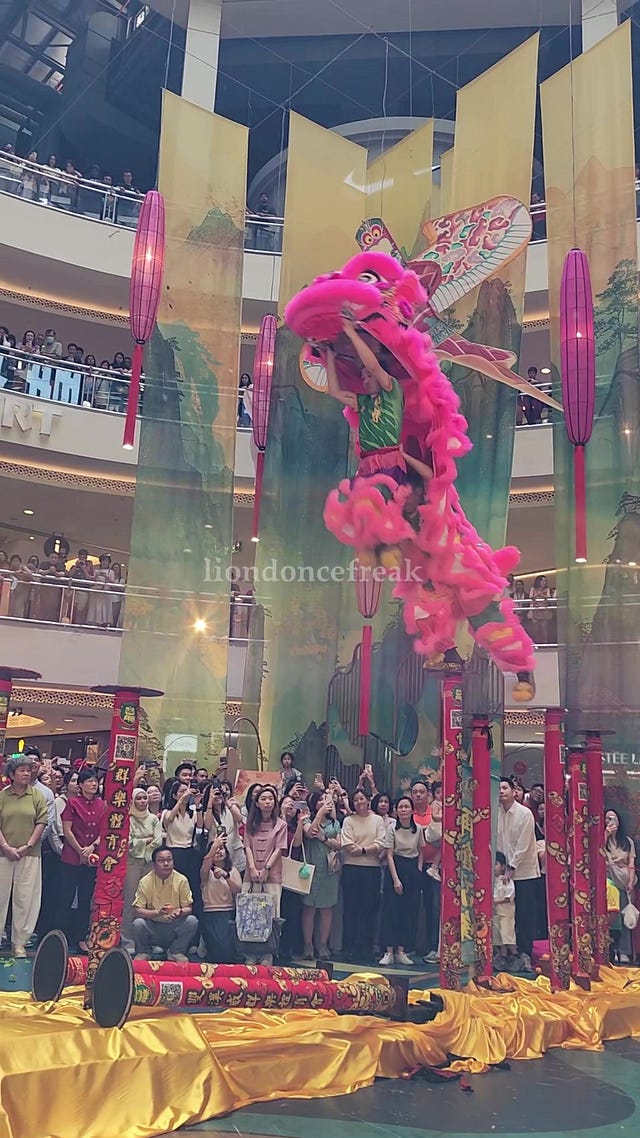
For example, I’ve only recently learned that lion dances performed on poles were created by the Malaysian Chinese diaspora. A fairly recent invention too—first appearing in 1983, in comparison to the 2000 years it’s been around as a practice. Yet this new style of performing the lion dance was quickly accepted and incorporated into performances and competitions.
 Tiktok failed to load.
Enable 3rd party cookies or use another browser
A video of a lion dance performance in Malaysia, where the two performers cleared a 3-meter jump on 2-meter tall poles.
It seems ironic how we cherry pick certain parts of “evolving” culture, depending on how much it benefits the larger community. Mainland Chinese have been praising Malaysian Chinese for “preserving” as much of “original” Chinese culture as possible, but we also celebrate our new year’s a little differently. We have something called “yee sang”, which is only found in Malaysia and Singapore. We also don’t release lanterns during Yuan Xiao Jie (the 15th day of the Chinese New Year); we throw oranges into a river instead.
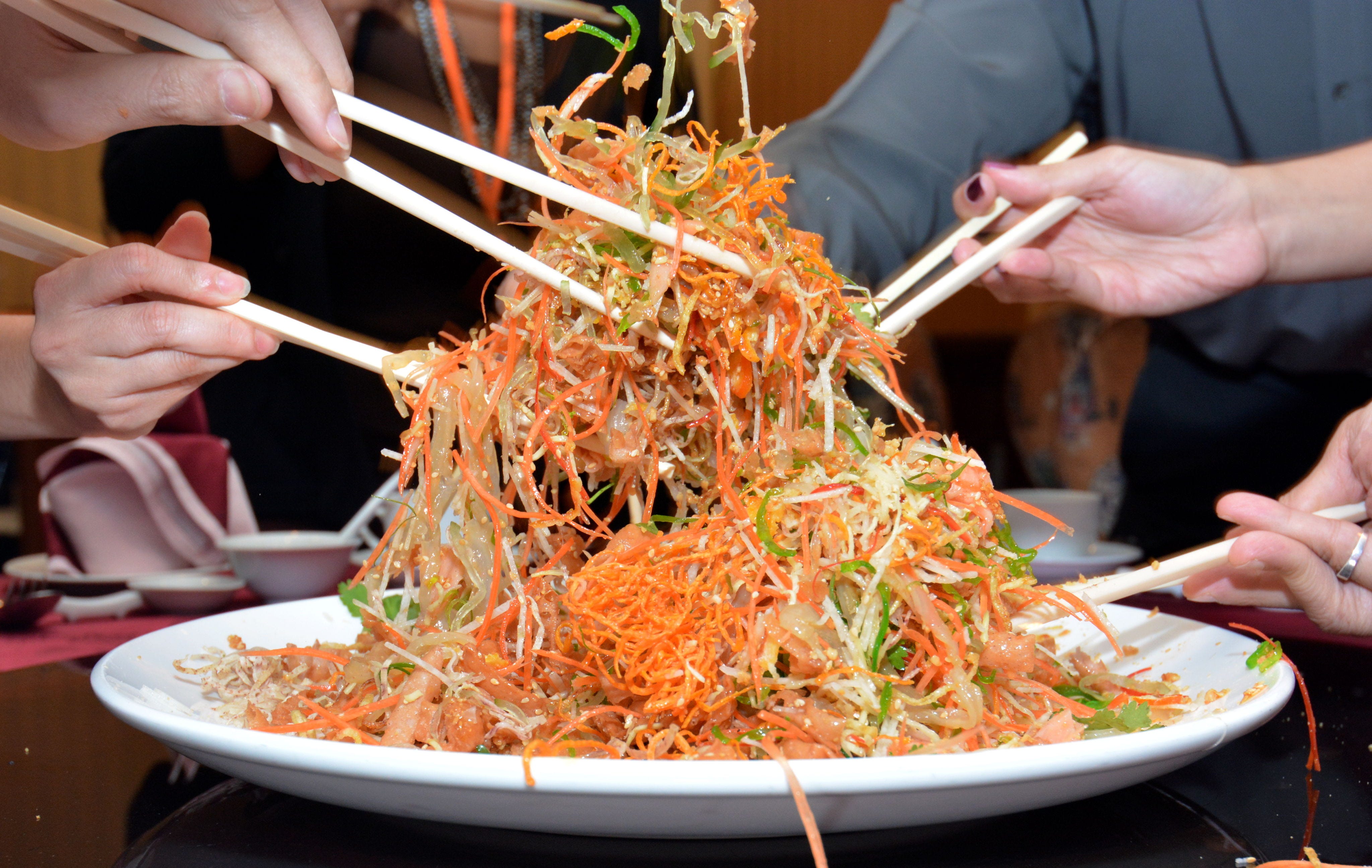
Tossing the yee sang; or trying make sure our food stays on the plate
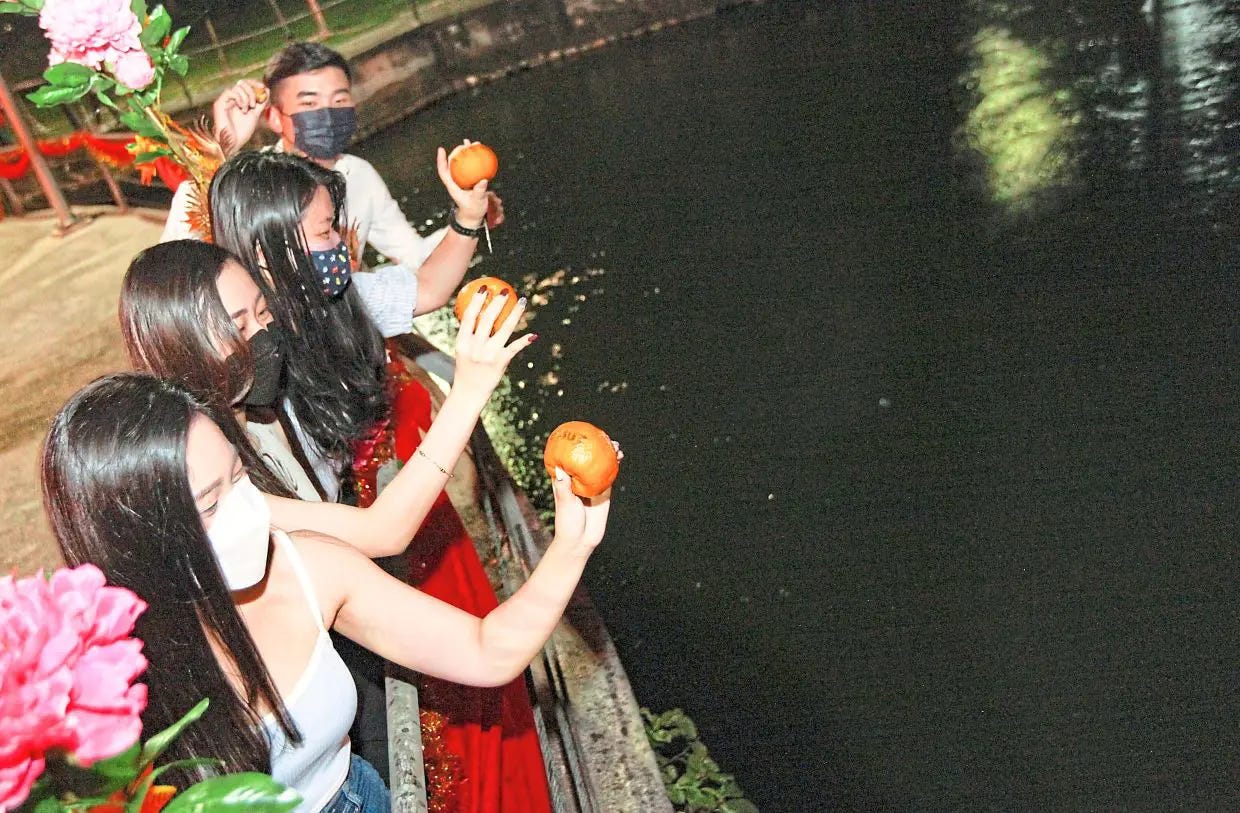
How Malaysia celebrates Yuanxiao Jie, or Chap Goh Meh; yes, the oranges are real
With our different new year practices, are we really “preserving” culture, or are we really taking our own spin on it, as our ancestors have always done, in response to our unique contexts and geopolitical situations?
In case you haven’t noticed, there are hierarchies within marginalised communities as well. If even a holiday is a subject of contention, you can imagine the many other things we often argue over.
But the point is, there are plural ways of doing culture. The way I celebrate is just one way. It does not discount how other communities celebrate the same festival. It is so easy for stories of less-politically powerful communities to get lost in larger narratives. I’m tired of seeing online communities argue over what is part of “Chinese” New Year or not. I’m even more tired of seeing the traditions of Southeast Asian diasporas get overshadowed by both Western and Eastern perspectives.
A mini new year’s resolution
This year, I’m making it a point to showcase more of Malaysian/Southeast Asian culture—but not from an exotic or otherworldly perspective, as is often framed by people outside the community. I want to show it by treating it as a normal part of my everyday life, to tell others that this is my part of the world. I’ve lived long enough to see Western or East Asian media proliferating my surroundings, and while it feels scary to go against dominant narratives, my own context is the reality I’m contending with.
As always, thank you for making it this far, especially since this post has nothing to do with my writing life! But I promise I’ll be back with more updates on that department. In the meantime, Happy New Year to everyone!
xx,
Amy
Fascinating insight on something I know virtually nothing about. Thank you for sharing this.
as you know I'm always here to yell about Malaysia. excited to see what you discuss Amy, and to see Southeast Asia celebrated together!
ps once someone with their full chest told me online that it was Malaysian New Year, not Chinese New Year lmao, ignoring the Malaysians in the chat all going "what are you talking about"